Free RV parking comes in two forms: dispersed sites on BLM and National Forest land, where stays usually run up to 14 days, and store, casino or truck-stop lots, which suit a single night if the manager agrees. Neither offers hookups. Arrive with water, power and a way to carry out your trash. For 14-day limits, the BLM field office or ranger district that covers the spot has the final word.
Which type of spot fits your trip
One night between two long driving days points to a store or truck-stop lot. Three or four nights points to public land, and that means hauling enough water and battery to last. If the rig itself is still unsorted, the camping in an RV hub covers the basics.
| Type | Typical stay | Permission needed | Hookups |
|---|---|---|---|
| BLM land (dispersed) | Up to 14 days | None at most sites; some areas want a permit | None |
| National Forest (dispersed) | Up to 14 days | None at most sites; district office has details | None |
| Retail lots (Walmart, Cabela’s, Cracker Barrel and similar) | One night | Store manager decides | None (some Fred Meyer stores in Alaska have a dump station) |
| Truck stops (Flying J, Pilot) | Typically a single night | Often allowed; confirm | None |
| Casino lots | Usually one night; some allow more | Business policy | None |
| City parks | Roughly 1 to 3 days where allowed | Local ordinance | None |
| County parks | Varies | Varies | Generally none |
| Rest areas | State-specific; some limit stays to a few hours, some prohibit overnight parking | Read the posted signs | None |
What to bring when nothing is provided
Free sites rarely have a water spigot, a dump station or a garbage can. Fill the fresh tank before you leave, start with empty gray and black tanks, and know where the nearest dump station is. Pack trash bags and a lidded bin.
For power, you need a generator, or solar with enough battery to run lights and the water pump. Download offline maps before you lose service, and save a second spot in case the first is full, closed or posted. A packing list for the tent and kitchen side of things lives in the list of things to pack for camping.
How to find and vet a spot
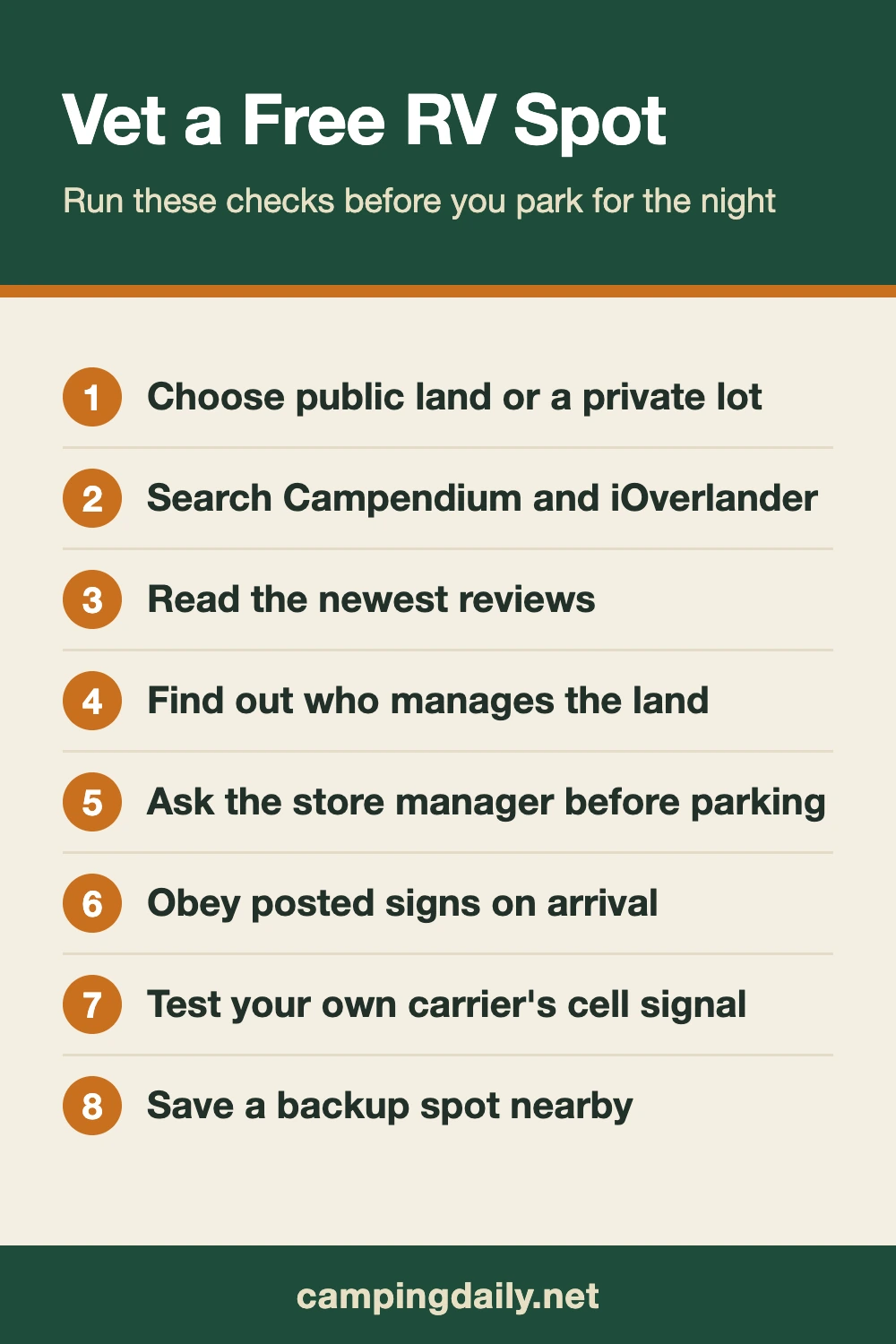
- Pick the land type. One night en route means a lot. Multiple days means BLM or Forest land.
- Search the apps. Campendium has a free-price filter and shows cell signal and road access. iOverlander is crowdsourced, but many users are in vans or cars, so check that a listing fits an RV. FreeCampsites.net is community-run and states that its data is not error-checked. The Dyrt’s free-campground filter needs a paid Dyrt Pro subscription. RV Life lists unreviewed spots as free by default, and Roadtrippers limits a free trip to three stops, with some paid parks showing up under its free filter.
- Read the newest reviews. A spot that was free in an older post may now charge, be gated or be closed, and the app entry won’t always say so. Recent comments beat the star rating.
- Find out who manages the land. Check the BLM field office or ranger district page, or call. Ask whether dispersed camping is allowed at that exact location, whether a permit or fire restriction applies, and whether the road suits your rig’s length and clearance.
- Ask inside the store. Go in or phone before you park. Ask where in the lot to sit and whether a city ordinance has changed recently. One manager’s yes tells you nothing about the next store.
- Obey the signs when you pull in. A “No overnight parking” sign beats any app listing.
- Test your own signal. Cell notes in Campendium come from other people’s carriers, so a “good cell” comment may not apply to yours.
Public land: BLM and National Forest
Dispersed camping means camping outside a developed campground, with no services. After the 14-day cap you move on, and some agencies expect you to relocate a set distance rather than hop to the next pull-off.
A long or low rig can bottom out or get stuck on dirt roads, especially after rain. Ask the ranger office about conditions, and walk the last stretch before you try to turn a big rig around.
Some areas, including some state, water-management or Army Corps lands, require a permit, sometimes free. “Free” can also mean no campsite fee but an access fee: North Maine Woods charges an entry fee at the gate, and some designated campsites there charge a fee as well. One reader reported getting a campfire permit through the local town fire warden office in Maine’s North Maine Woods. Fire restrictions shift with the season, so get current rules from the land manager.
Store lots, truck stops and casinos
Walmart is the best-known option, but policy is set store by store and some cities ban overnight parking outright. Cabela’s, Bass Pro, Cracker Barrel, Lowe’s, Home Depot, Costco and Sam’s Club get named as candidates too, with the same store-by-store answer. Flying J and Pilot truck stops often allow RVs overnight, and the Flying J app lists locations. Casino lots depend on business policy, which can change without notice. Viejas, for example, allows up to three days, so ask at each casino.
Park at the edge, away from the entrance and out of delivery lanes. Keep slides and awnings in, and leave the tents and chairs packed. Skip the generator at night, especially with neighbors close by. If you have to run one, keep it outdoors with the exhaust pointed away from the rig and neighbors, keep nearby windows, doors and vents closed, and have a working CO alarm inside. Never run it in an enclosed space.
Leave in the morning. Buying gas, groceries or dinner there is a fair thank-you for the spot.
Harvest Hosts and Boondockers Welcome are paid alternatives that require memberships, which makes sense if no free option works out. Planning a lot stop as one night of a longer drive? The road trip plans for camping page covers how to space the driving days.
Rest areas
Some states limit stays to a few hours and some prohibit overnight parking. Campendium says Michigan has several rest areas where you may stay for a limited time, and the posted signs at each one govern. Even where a stay is allowed, plan to sleep for a few hours rather than set up: slides and awnings stay in, and you stay inside the rig.
Dry camping math: water, power and waste
Write down how many gallons your fresh tank holds, then watch how fast it drops over a normal day of dishes, teeth brushing and a short shower. That figure tells you how many days you can stay, far better than a forum guess. Run the same test on the gray tank, since it can fill before the fresh tank empties on some rigs. Keep drinking water separate and use only potable water for drinking.
A generator at 10 p.m. next to other campers is a quick way to get a knock on the door. Solar with a battery bank runs silent, and that is the main reason to price it out if you boondock often.
Heat needs care. Never use a camp stove, grill, or any fuel-burning portable heater to warm the rig, and do not run kerosene heaters inside. If the rig has a built-in RV furnace or a heater made for RV use, install and vent it exactly as the manufacturer says, and keep a working CO alarm in the sleeping area. Test the CO and propane alarms before each trip and ventilate while cooking. The heater for camping guide covers heater choices.
Regional starting points
- Florida: Campendium lists Bayside Campground (Pensacola), Cotton Lake, Battery Park (Apalachicola), Potts Preserve, Hampton Tract, and the Osceola and Ocala National Forests. Cotton Lake and Dead River Landing require a reservation, and Potts Preserve and Hampton Tract require a free reservation.
- California: free camping for RVs does not exist inside Joshua Tree National Park itself; spots listed are nearby (along the I-10 corridor, for example). Mojave National Preserve has several listed free sites. For the coast, see beach camping in California.
- Colorado: the Crested Butte and Leadville areas have listed spots, and the I-70 corridor has BLM land near Grand Junction, such as 25 Road. Older listings may have gained fees or closed.
- Maine: readers report that most Walmarts in Maine and a designated RV area near L.L. Bean in Freeport allow overnight parking; Freeport can get crowded in summer. State park sites are paid. For a national-park option, see camping at Acadia National Park.
- Michigan: several rest areas allow limited stays. For scenic stops in the north, the waterfalls in Michigan’s Upper Peninsula page is a good reference.
Mistakes that get people cited
Sleeping on a residential street is the quick way to a ticket, because police can enforce local ordinances there and fines are possible. Pick a lot or public land instead.
Trash is the other one. Leaving it behind is one of the habits that can get lots and public land closed to RVs, so pack everything out.
Frequently asked questions
Are there places to park an RV for free?
BLM and National Forest land are the best bets for dispersed camping, and store, casino and truck-stop lots work for one night once a manager agrees. City parks and some county or state lands may allow short stays under local ordinances. None of these provide hookups, so fill your water tank and charge your batteries before you go.
Where can I stay for free in an RV for more than one night?
Dispersed camping on BLM or National Forest land, where stays are usually capped at 14 days. Call the field office or ranger district covering your area for its exact limit. Lots and rest areas are built for a few hours or one night, and staying longer risks a citation.
Where can I park my RV for free in Florida?
Campendium lists Bayside Campground in Pensacola, Cotton Lake, Battery Park in Apalachicola, Potts Preserve, Hampton Tract, and the Osceola and Ocala National Forests. Cotton Lake and Dead River Landing require a reservation, and Potts Preserve and Hampton Tract require a free reservation. Some water district areas also need a permit.
Do all Walmarts allow RV parking overnight?
No. Each store’s manager decides, and some cities ban overnight parking entirely. Go inside or phone, then read iOverlander reviews for that address. If the answer is yes, park at the edge of the lot and keep everything pulled in. If it’s no, move on without arguing.
Is a rest area a legal place to sleep in an RV?
It depends on the state. Some cap stays at a few hours, others prohibit overnight parking, and Campendium says Michigan has several rest areas with limited-time stays. Whatever the signs at that rest area say is the rule, so read them before you settle in.