A camping dutch oven is a cast iron pot with three short legs, a bail handle and a flat, rimmed lid that holds hot coals on top. Pick a 2-quart for one or two people, a 5 or 6-quart for three to six, and an 8 to 10-quart for seven or more. Skip enameled and domed-lid kitchen models for fire use. They are built for a stove, not a campsite.
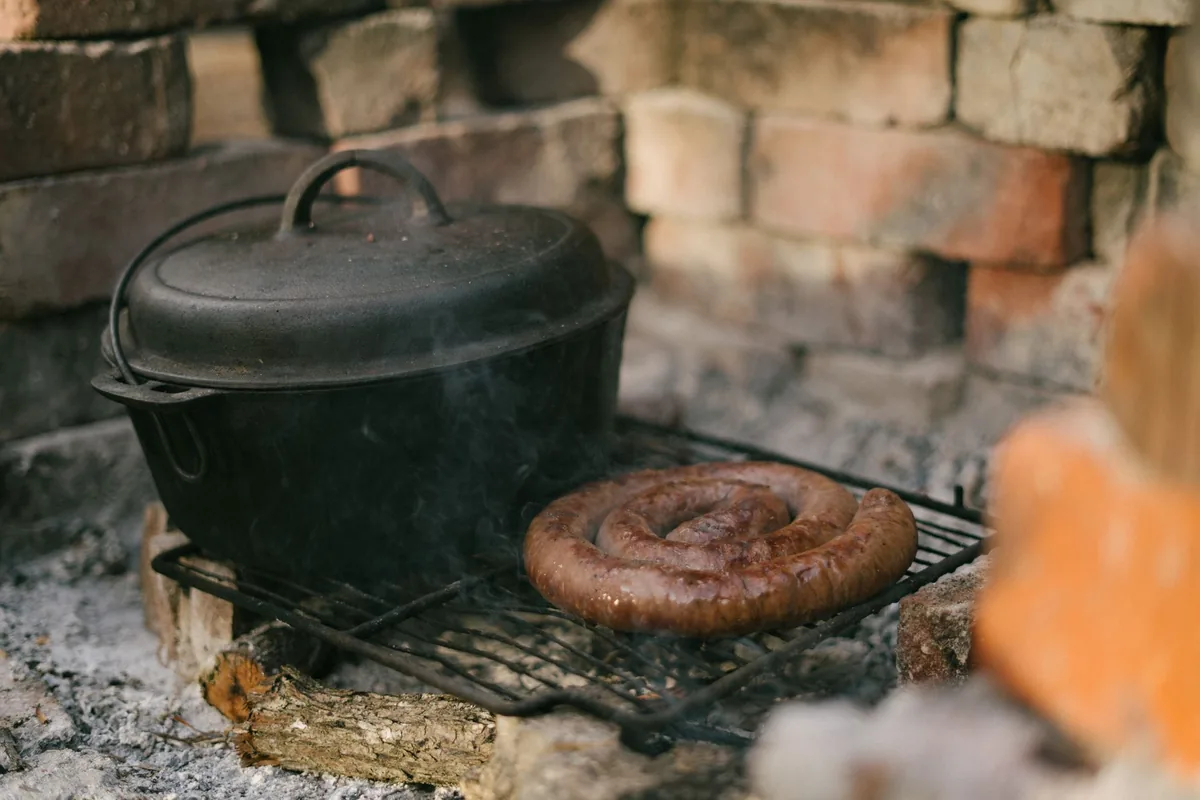
What makes a camp Dutch oven different from a kitchen one
Start with the legs. Three short legs keep the pot level on uneven ground and leave a gap underneath for coals and airflow. A flat-bottomed pot set straight onto coals smothers them and heats unevenly. One Amazon reviewer of a flat-bottomed model wrote that it has no feet, smothers the coals and is not suited to campfire use. Listings can be loose with the word “camp,” so look at the photos for actual legs.
The lid matters just as much. It needs a raised rim or recess so the coals stay put on top, which a domed lid, common on indoor Dutch ovens, cannot do. Turned upside down, a flat lid can double as a griddle, and some models are sold with that in mind.
The wire bail handle is the third piece. It lets you hang the pot from a tripod or lift it with a hook.
Lodge says its camp ovens are meant for campfire and direct flame and are not for indoor use. That is a manufacturer claim, so pair it with the handling rules further down.
Cast iron or aluminum?
Cast iron soaks up heat and evens out the spikes of a fire, and it takes direct coals without complaint. Most camp recipes and coal charts assume it.
Aluminum wins on weight, which counts if you carry gear any distance from the car. The cost is hot spots. Food scorches sooner, and timing shifts with coal size and how full the pot is, so you end up standing over it.
Enameled cast iron is a separate case. The enamel can crack or chip under direct flame, and chips can end up in food. Keep enameled pots for the stove and oven at home.
Which size to buy
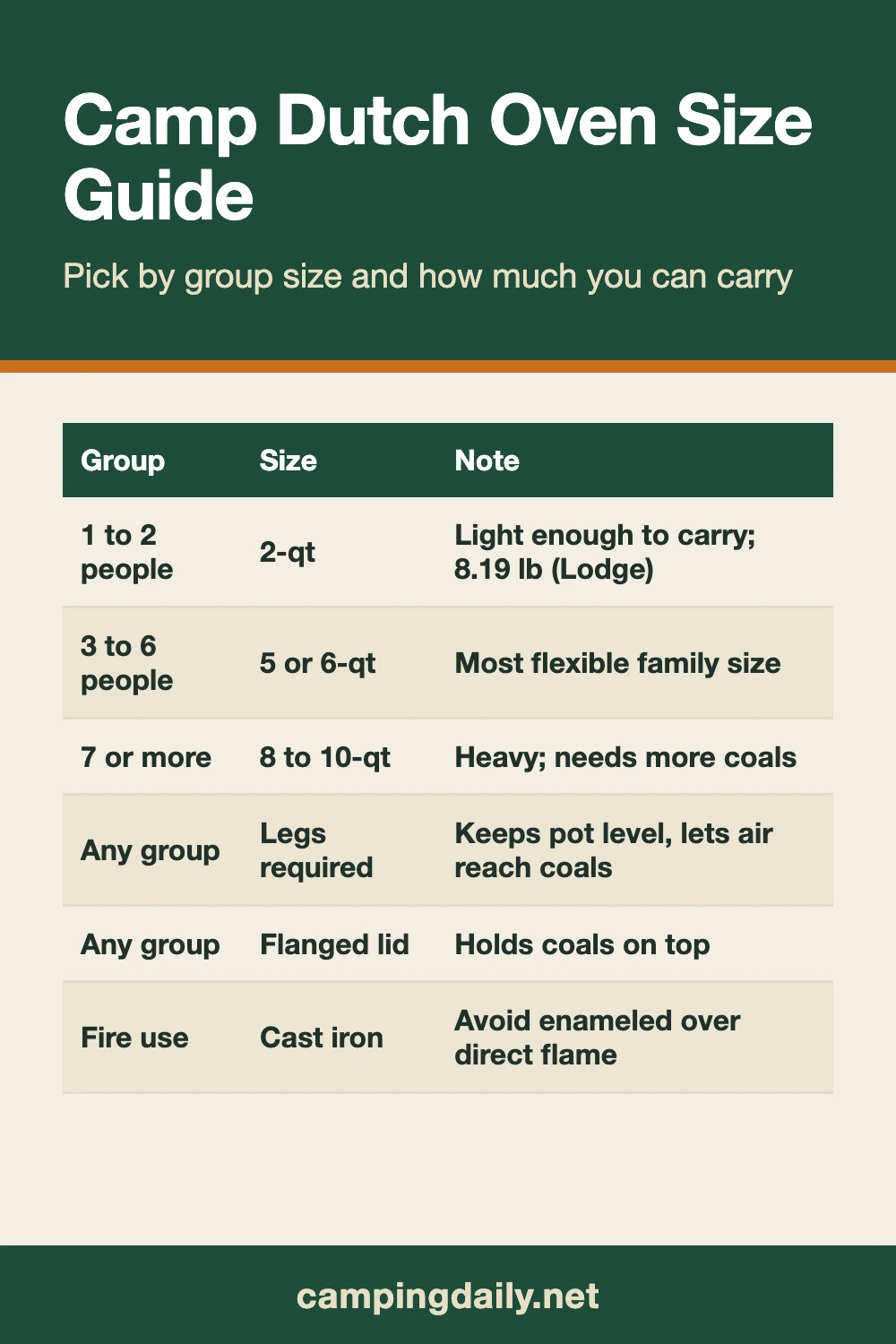
| Group size | Typical size | Notes |
|---|---|---|
| 1 to 2 people | 2-qt | Fine for a stew, small casserole or pot of beans |
| 3 to 6 people | 5 or 6-qt | The most flexible size for a family |
| 7 or more | 8 to 10-qt | Heavy, and needs more coals and a bigger fire ring |
Lodge makes camp ovens in 2, 4, 5, 6, 8 and 10-quart sizes. Its 2-quart camp oven weighs 8.19 lb and measures about 9.75 in long, 8.43 in wide and 5.75 in tall, with a list price of $69.95 as of October 2026 (confirm on the Lodge site). That is the smallest size, and larger ones weigh a lot more. Weight came up in reviews of one 9-quart cast iron camp oven on Amazon, with buyers split on whether it was heavy.
Size also controls fuel. Coal counts scale with the diameter of the pot, so a 12-inch oven burns noticeably more charcoal than a 10-inch.
Types of camp Dutch oven, compared
| Type | Good for | Watch out for |
|---|---|---|
| Bare cast iron, legs, flanged lid | Coals, fire pit, tripod cooking | Heavy; needs seasoning and drying |
| Pre-seasoned cast iron | Quick start, less prep | Some buyers report a rough surface where food sticks |
| Flat-bottom cast iron | Stovetop and oven at home | Smothers coals at camp; no airflow underneath |
| Enameled cast iron | Home cooking, easy cleanup | Enamel can crack or chip over direct flame |
| Aluminum camp oven | Weight savings | Hot spots; scorches faster; needs closer watching |
“Pre-seasoned” means only that the factory put an oil coating on the pot. It doesn’t promise a smooth surface. One buyer reported a rough surface where food stuck, and the fix is in the seasoning section below.
Price and brands
The brands that come up most are Lodge, Camp Chef and Ozark Trail, with GSI and Bruntmor also appearing. Ozark Trail is sold at Walmart and gets pitched as good value for infrequent campers. Lodge’s 8-quart deep camp oven carries a 4.8-star rating from about 7,000 reviews on Amazon. Prices and review counts move, so confirm them on the listing.
One 9-quart pre-seasoned model on Amazon lists a 500°F rating, lid lifter included, hand wash only. Do not treat a rating like that as a safe limit over an open fire. A campfire can run hotter than any number printed on a listing, and the figure has no stated test behind it. The same listing gives the diameter as 12 inches in the bullets and 12.6 inches in the specs, so measure against your fire ring and your storage bin rather than trusting the page.
If you want one pot, buy a 5 or 6-quart in bare or pre-seasoned cast iron, with legs. Add a second size later only if you keep running out of room.
Accessories worth buying
A lid lifter or channel-lock pliers comes first, because lifting a lid covered in coals with your hands is how people get burned. Heat-resistant gloves or a leather oven mitt come next, since cast iron stays hot long after the fire dies.
Long metal tongs handle placing and moving briquettes, and a chimney starter lights them. A tripod with adjustable height lets you simmer or hang the pot over a fire. For cleanup, bring a stiff brush or pan scraper, and carry the pot in an oven bag or sturdy tote so soot stays off everything else in the car.
How to use a camping dutch oven
Many campers use charcoal briquettes because they can be counted and adjusted, though some cook over wood coals or hang the pot from a tripod. The pot is one piece of a larger kitchen, and the list of things to pack for camping covers the rest.
Lighting and placing coals
- Light briquettes in a chimney starter and wait until they are mostly covered in white ash. A chimney beats lighter fluid. If you do use fluid, never add it to coals that are already lit.
- Set up on bare, level ground or a non-flammable surface in your fire pit, away from tents, dry grass and overhanging branches.
- Spread the bottom layer of coals, set the oven on top, then spread the top layer evenly on the lid.
- Keep the lid closed. Lifting it early drops the temperature and lets ash fall into the food. Check when it smells done.
How many coals?
Rules of thumb vary, so treat any count as a starting point. Charts also disagree with each other, and the practical answer is to adjust by watching the food.
For a 12-inch oven, one common method doubles the diameter to get 24 coals total, then puts about three quarters of them on the lid: 18 up, 6 down. Too much heat underneath can scorch the base, so start with fewer coals below and adjust.
Roasting, frying and stewing each need a different split. Roast with the same number of coals above and below. Stew with the heat mostly underneath, about four times as many coals under the pot as on the lid, and check the pot often, because that much bottom heat can burn the base. Frying puts every coal under the pot, with a count close to the oven’s diameter in inches. Hot oil beside an open fire is a fire hazard, so keep the oil shallow and keep a lid or flat sheet within reach to smother flames.
Adding or removing two coals shifts the temperature by roughly 25°F. A sealed oven at 350 to 400°F inside suits most baking. For a 10-inch or 14-inch oven, start from two coals per inch of diameter and watch the first cook closely.
Skip the trick of holding a palm over the open oven and counting seconds. It varies from person to person. A cheap oven thermometer gives you an actual number.
Wind and cold
Wind and cold can mean you need more briquettes to hold temperature. If the wind is strong, set up a non-flammable windbreak such as rocks, kept clear of the coals.
What to cook
Slow, wet and baked food suits the pot: chili, pot roast, braised short ribs, baked pasta, cobbler. Bread is the surprise. The closed lid holds steam in, so the loaf comes out with a crisp crust and a soft middle.
Two examples for a 12-inch oven. Check doneness yourself.
| Dish | Serves | Briquettes | Time |
|---|---|---|---|
| One-pot cheesy pasta | 6 to 8 | Start 25 to 30; 10 to 12 under, 15 to 18 on top | About 1 hour |
| Berry coffee cake | 6 to 8 | Start 25 to 30; 8 to 10 under, 12 to 15 on top | About 40 minutes |
If you’d rather see the technique first, Texas Parks and Wildlife has a short video that walks through chicken stew, beef stew and beans. Its description also mentions free Dutch oven cooking classes at Texas state parks, so check with the park for current schedules. For coal counts and full recipes, go to Dutch oven camping recipes, and for the sweet side, campfire desserts.
Cleaning, seasoning and storage
A cast iron pot that goes away wet will rust.
- Scrub with a stiff brush and hot water while the pot is still warm.
- For stuck-on food, simmer water in the pot for a few minutes first, then scrape.
- Dry it completely. Warm to the touch is a good sign it will dry fast.
- Rub a thin coat of oil over the inside.
Metal utensils can scratch enameled models, which is one more reason to leave those at home.
Seasoning is a thin layer of oil baked on by heat. It guards against rust and builds a nonstick surface over time. A pre-seasoned pot that feels rough and grabs food usually improves with thin coats of oil and a few greasy cooks, bacon or sausage for example. Oil the pot after every wash.
For storage, keep it dry with the lid slightly ajar, or put a paper towel between lid and pot so moisture escapes. Brush off any rust, dry the pot, and re-oil.
Safety limits
Never use a fuel-burning pot setup inside a tent, camper or vehicle. Charcoal and wood fires produce carbon monoxide, and Lodge puts a California carbon monoxide warning on its ovens for combustible fuel. Cook outdoors, in open air, and keep coals out of any enclosed space.
Don’t dry a wet pot over low heat on coals with food still inside or nearby. Dry it off the fire. Handle the lid with a lifter or pliers, and set it on a clear surface, not the dirt, so ash does not fall in.
Deep frying at camp carries a real fire risk, so never leave the pot unattended. When you finish, put coals out fully: let them burn to ash, drown them with water and stir, or use a metal ash bucket. Check the fire rules at your campground first.
For leftovers, refrigerate cooked food within about two hours, or one hour in hot weather. Keep a food thermometer on hand for meat; the USDA lists the safe internal temperatures.
Frequently asked questions
Is a Dutch oven good for camping?
Yes, if you want slow-cooked or baked food at camp. It handles stews, chili, bread and casseroles that a camp stove and a single pan cannot. The tradeoff is weight. A 2-quart cast iron camp oven weighs over 8 lb, and larger ones weigh more.
What is the difference between a Dutch oven and a camp oven?
A camp oven has three legs, a flat rimmed lid that holds coals and a bail handle. A regular Dutch oven has a flat bottom and often a domed lid, made for the stove or oven at home. Some brands sell both under similar names, so look for the legs.
What is the best Dutch oven for camping?
A 5 or 6-quart cast iron camp oven with legs and a flanged lid covers most groups of three to six. Lodge and Camp Chef are the names you will see most, and Ozark Trail is the budget pick sold at Walmart.
What is the best size Dutch oven for camping?
Use a 2-quart for one or two people, a 5 or 6-quart for three to six, and an 8 to 10-quart for seven or more. If you are unsure, pick the 5 or 6-quart: it is large enough for a family and still manageable to carry.
How do I use a camping Dutch oven?
Light briquettes in a chimney starter until mostly ash-white. Spread some on the ground, set the oven on top, then place the rest on the lid. Keep the lid closed, add or remove two coals to shift the temperature about 25°F, and lift it only when the food smells done.
What are the benefits of using a camping Dutch oven?
It bakes, braises and simmers in one pot and works on coals when you have no stove. One heavy pot can replace several pans, and the lid traps steam so bread gets a crisp crust.
What are some popular recipes for a camping Dutch oven?
Chili with cornbread, one-pot pasta, mac and cheese, berry buckle, coffee cake, cast iron nachos and Dutch baby pancakes all work. Coal counts and timing are in the Dutch oven camping recipes.
How do I maintain a camping Dutch oven?
Scrub with a brush and hot water, simmer water to loosen stuck food, dry it fully while still warm and rub a thin coat of oil inside. Store it dry with the lid slightly open. Rust can be brushed off and the pot re-oiled.
What are the different types of camping Dutch ovens?
The main types are bare cast iron, pre-seasoned cast iron, flat-bottom cast iron, enameled cast iron and aluminum. For campfire cooking, get cast iron with legs and a flanged lid. Enameled and flat-bottom pots belong in the home kitchen.
Bring the lid lifter and gloves, and work out the rest of the packing with how to plan a camping trip.